



DE LA MONDIALISATION À LA SLOWBALISATION
Synopsis de l’article
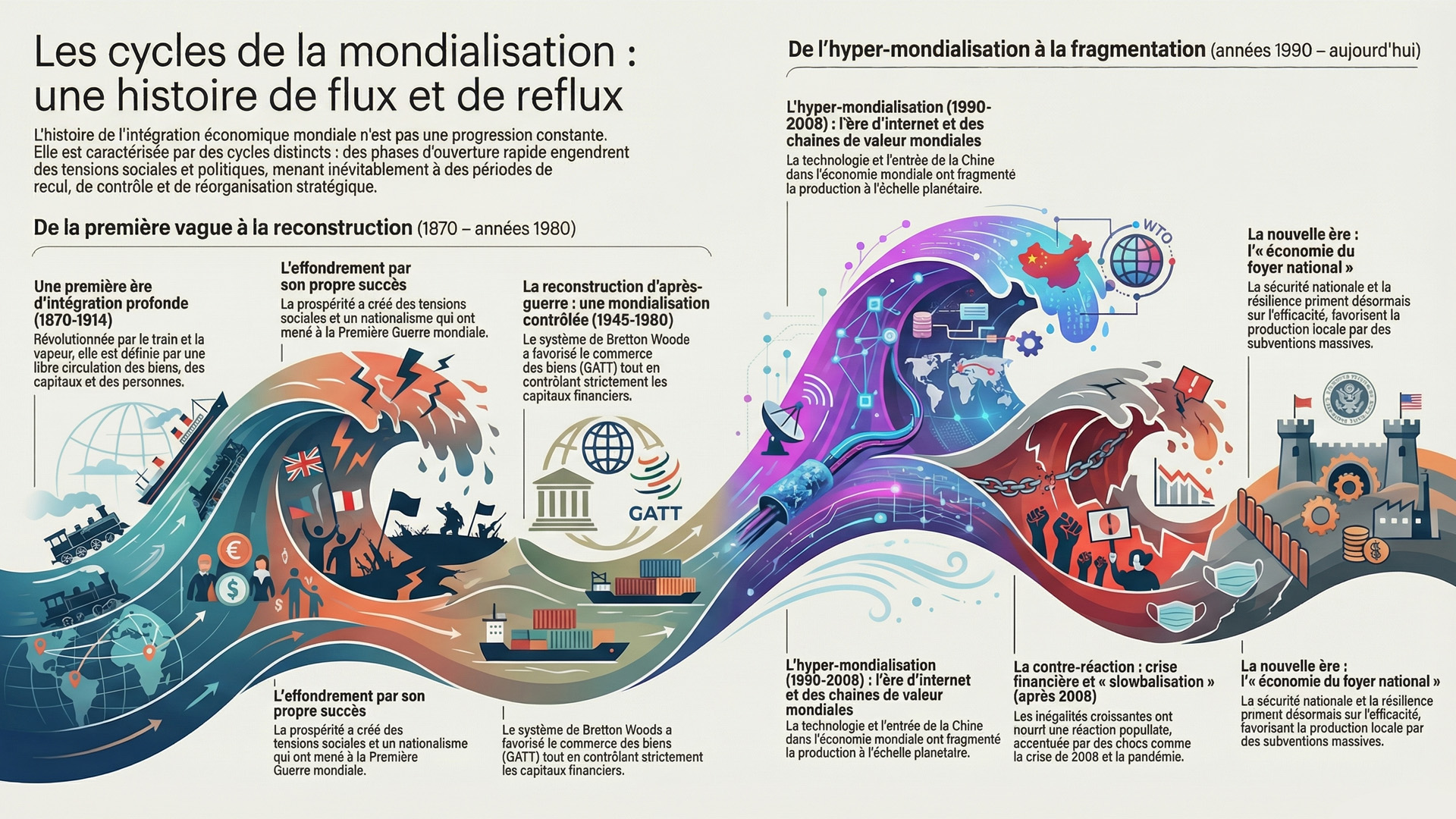
Cette analyse déconstruit le mythe d’une mondialisation linéaire pour la présenter comme un processus historique cyclique, alternant entre intégration intense et rejets violents. En retracant l’essor et l’effondrement de la première vague en 1914, la reconstruction contrôlée de l’après-guerre et les excès de l’« hyper-mondialisation » récente, l’auteur démontre que nous sommes entrés, à la suite de chocs cumulatifs comme la crise de 2008 et la pandémie, dans une ère de « slowbalisation » et de fragmentation géopolitique,. Ce nouveau paradigme remplace la recherche de l’efficacité pure par une « économie du foyer national » axée sur la sécurité et la résilience, signalant un retour durable des frontières et des stratégies étatiques au détriment du marché global unifié.
Sources
Acemoglu, D., & Restrepo, P. (2018). The Race Between Man and Machine: Implications of Technology for Growth, Factor Shares, and Employment. American Economic Review, 108(6), 1488-1542.
Amsden, A. (2001). The Rise of “The Rest”: Challenges to the West from Late-Industrializing Economies. Oxford University Press.
Balassa, B. (1981). The Newly Industrializing Countries in the World Economy. Pergamon.
Baldwin, R. (2016). The Great Convergence: Information Technology and the New Globalization. Harvard University Press.
Baldwin, R., & Evenett, S. (eds.). (2020). COVID-19 and Trade Policy: Why Turning Inward Won’t Work. CEPR Press.
Berend, I. T. (2016). An Economic History of Nineteenth-Century Europe: Diversity and Industrialization. Cambridge University Press.
Bordo, M., Eichengreen, B., & Irwin, D. (1999). Is Globalization Today Really Different than Globalization a Hundred Years Ago? NBER Working Paper No. 7195.
Bordo, M., & James, H. (2019). The Economic Lessons of the 1930s. In The Cambridge Economic History of Modern Europe. Cambridge University Press.
Bown, C. (2022). US-China Trade War Tariffs: An Up-to-Date Chart. Peterson Institute for International Economics.
Brunnermeier, M., James, H., & Landau, J.-P. (2021). The Euro and the Battle of Ideas. Harvard University Press.
Crafts, N. (2004). Globalisation and Economic Growth: A Historical Perspective. The World Economy, 27(1), 45-58.
Eichengreen, B. (1996). Globalizing Capital: A History of the International Monetary System. Princeton University Press.
Eichengreen, B. (2018). The Populist Temptation: Economic Grievance and Political Reaction in the Modern Era. Oxford University Press.
Eichengreen, B., & Irwin, D. (2010). The Slide to Protectionism in the Great Depression: Who Succumbed and Why? Journal of Economic History, 70(4), 871-897.
Farrell, H., & Newman, A. (2019). Weaponized Interdependence. International Security, 44(1), 42-79.
Feenstra, R. C. (1998). Integration of Trade and Disintegration of Production in the Global Economy. Journal of Economic Perspectives, 12(4), 31-50.
Findlay, R., & O’Rourke, K. (2007). Power and Plenty: Trade, War, and the World Economy in the Second Millennium. Princeton University Press.
Gerschenkron, A. (1962). Economic Backwardness in Historical Perspective. Harvard University Press.
Helleiner, E. (1994). States and the Reemergence of Global Finance. Cornell University Press.
Hobsbawm, E. (1987). The Age of Empire: 1875–1914. Vintage.
Hummels, D. (2007). Transportation Costs and International Trade in the Second Era of Globalization. Journal of Economic Perspectives, 21(3), 131-154.
Irwin, D. (1995). The GATT’s Contribution to Economic Recovery. In Bordo, Goldin & White (eds.), The Defining Moment: The Great Depression and the American Economy in the Twentieth Century. University of Chicago Press.
Irwin, D. (2020). Clashing over Commerce: A History of US Trade Policy. University of Chicago Press.
James, H. (2001). The End of Globalization: Lessons from the Great Depression. Harvard University Press.
Krugman, P. (2008). Trade and Wages, Reconsidered. Brookings Papers on Economic Activity, 39(1), 103-154.
Maddison, A. (2001). The World Economy: A Millennial Perspective. OECD.
Obstfeld, M., & Taylor, A. (2004). Global Capital Markets: Integration, Crisis, and Growth. Cambridge University Press.
Rodrik, D. (2011). The Globalization Paradox: Democracy and the Future of the World Economy. W. W. Norton.
Rodrik, D. (2023). The Return of Industrial Policy. Project Syndicate / Harvard Kennedy School.
Rossi-Hansberg, E. (2006). The Rise of Offshoring: It’s Not Wine for Cloth Anymore. Princeton University.
Scheve, K., & Slaughter, M. (2007). Globalization and the Perceptions of American Workers. Brookings Institution Press.
Stiglitz, J. (2002). Globalization and Its Discontents. W. W. Norton.
Taylor, A. (2013). The Great Divergence Reconsidered: Capital Markets and International Trade in the First Globalization. American Economic Review, 103(3), 376-381.
Temin, P. (1989). Lessons from the Great Depression. MIT Press.
Tooze, A. (2018). Crashed: How a Decade of Financial Crises Changed the World. Viking.
Williamson, J. G. (1998). Globalization and the Labour Market: Using History to Inform Policy. NBER Working Paper No. 6760.
SYNTHÈSE
© Pierre Fraser (PhD, linguiste et sociologue), 2020-2025
Résumé
On décrit ici la mondialisation comme un cycle historique : l’hyper-intégration cède désormais place à une ère fragmentée priorisant la sécurité économique nationale.
ENJEUX DE SOCIÉTÉ






 Laboratoire d'analyse des récits contemporains